
August 16, 2026
I’ve been asking people a slightly uncomfortable question lately. What would happen if your company stopped running surveys tomorrow?
Chaos? Maybe civilisation collapses. NPS becomes unmeasured. Dogs and cats living together. 😱
Actually, your customers would still buy things. Your employees would still come to work. Your systems would still operate.Your business would simply carry on. And I strongly suspect - in this doomsday NPS scenario - your score doesn’t suddenly plunge simply because nobody asked the question.
Which is awkward, because some companies have spent millions for the privilege of watching the same line move from 31 to 32 to 30 to 31 again. Honestly? That line has had a more stable career than most executives. In fact it's been around 20 years. Same graph. Different PowerPoint template.
So here’s an even more uncomfortable question: If your score hasn’t materially changed in years, and you can’t clearly point to what changed because of the feedback - then what exactly have you been buying?
Charts.
Very expensive charts.
Charts with filters.
Yet, we all keep hearing versions of the same thing from both our customers and employees:
Nobody is listening. And nothing ever changes.
Worse, there seems to be a growing backlash against the whole ritual.
When I get one of those “Please take 10 minutes to tell us about your experience” messages it gives me the ick. Not because I don’t have opinions. Because I’ve been trained to expect two things.
First, the questions probably won’t let me say what I actually think. So, I’ll spend ten minutes fighting my way through someone else’s version of what matters about my experience and end up more annoyed than when I started. And second, even if I do manage to say what I mean, what are the chances anything actually changes as a result?
Probably close to zero.
At some point - and I strongly believe that point was approximately yesterday - repeatedly asking without visibly acting started to damage our relationships. And so, at what point will organisations consider that we have been focused on solving the wrong problem?
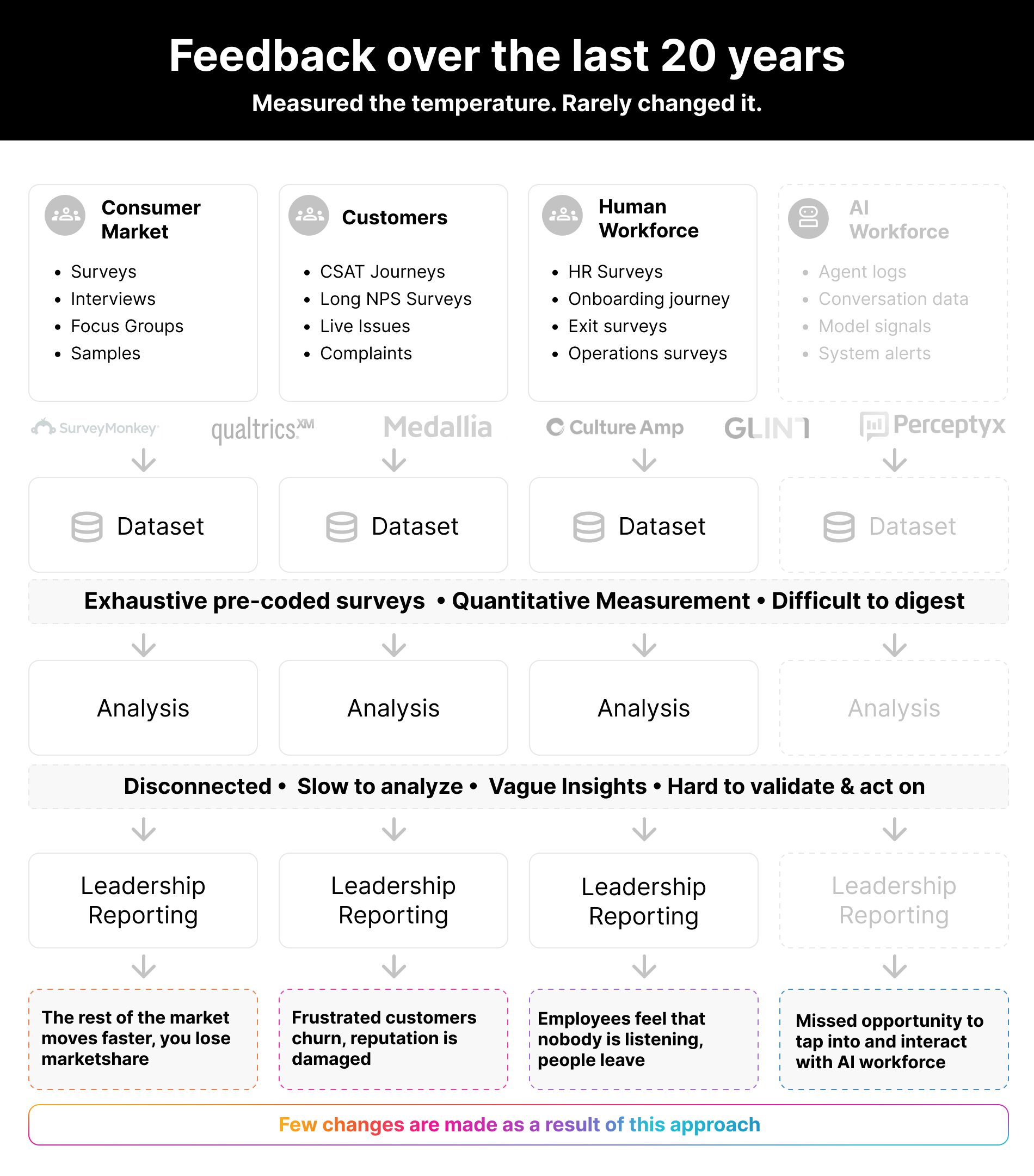
This is roughly how feedback still works. Someone decides what they want to know. Someone designs a survey.Someone agonises over the questions, only for another to wear them down one minor edit after another. Sometimes (read: most times) it evolves into a horrific monster that nobody enjoys answering.
The results appear in a dashboard. But, nobody really looks at that. If they do, they’re not really sure what it means.
So, someone analyses the verbatims. Someone else prepares a presentation with sentiment and themes. Another someone holds a meeting to talk about these vague themes.
And hopefully, eventually - in a galaxy far, far away -somebody does something. God knows if it’s the right thing. Most often it’s nothing.
And this is happening across multiple teams, each looking at just their limited viewpoint of a much bigger picture. How frustrating must it be to work so bloody hard knowing that it’s probably not going to make a difference?
We have become incredibly sophisticated at measuring NPS, CSAT, engagement, sentiment, drivers and benchmarks.
What we are much less sophisticated at is answering the question that should probably have come first:
What should we actually change?
Because the reason organisations ask for feedback was surely never to produce a line graph hovering forever on the same horizon. The point was to make something better. Yet we somehow built an enormous industry around measuring the temperature rather than changing it.
Traditional feedback was designed for a world where talking to thousands of people was difficult. But here we are in 2026. AI can have millions of unique conversations at once. It can ask a logical follow-up based on what somebody just said.
And yet the dominant feedback experience is still: Please rate your experience from 0–10.
Surely we can do better than this?
So, lets say I've launched a survey and here you are, confronted with that very question:
"Please rate your recent experience with us from 0 to 10"
You reply:
"0"
“What was the main reason for your score?”
You reply:
“It was a terrible experience.”
That's not helpful, in fact it's awful. Often a survey ends there. Either that, or it forces you down a rabbit hole of another 10 to some ridiculous number of questions you never cared to answer.
But what if I asked instead:
“What happened that affected your experience with us?”
You reply:
“I called you, because I wanted to stay. You increased the monthly price, I found a competitor offering basically the same thing for much less, and your agent wasn’t allowed to match it.”
Well, shit. That is considerably more useful. And now the next question is obvious.
“What would make you reconsider?”
A real outcome focused conversation naturally goes there. A static survey never would. That is one of the things AI changes completely.
The problem with a pre-coded survey: it assumes I knew all the right questions to ask before our conversation even started.
The old model was: design the questions, then collect the answers.
The new model is: Define the problem, start the conversation, then discover the questions.
Effectively, I can ask less and learn more. Faster.
By way of example: Lets, say thousands of customers are up for renewal today.
Take your pick of what: It could be streaming, insurance, software, gaming, mobile, broadband, gym membership, a loan- you name it.
Yesterday, your offer was competitive. Today, a major competitor launches an equivalent offer at 30% less. The market knows immediately. Customers know immediately.
Your feedback system probably doesn’t.
A customer contacts you:
“I’d rather stay, but they’re offering basically the same thing for $100 less per year. Can you match it?”
Your human frontline agent does not have the authority to approve a price match. So, they escalate to a churn risk team.
So does the next one.
And the next.
The churn risk team become inundated with approvals.
Your AI service agent receives the same request at scale.
But its rules don't allow it to authorise the price match either. So it transfers the customer to more frontline agents.
Thousands of customers wait endlessly, eventually give up, and churn.
And how long does it take for you to see the measurement (NPS dropping, churn increasing)?
How long does it take for you to understand the cause?
How long does it take for you to address the problem?
I can tell you how long: too long.
Customers are saying:
“I’ll stay if you match the price.”
Frontline teams are saying:
“Every price match requires manager approval. And i'm stuck on hold with the customer waiting for it.”
AI agents are reporting:
“Retention transfers are rising because I lack discount authority.”
Market intelligence says:
"Competitor Y launched a comparable offer this morning at 30% below ours."
Operational data says:
"Churn is up 27% compared with yesterday."
That is not five interesting pieces of information.
It is one problem.
And it is happening right now.
Most large organisations already have more data than they know what to do with.
The difficult question is not: What happened?
It is: What does it mean, and what should we do about it?
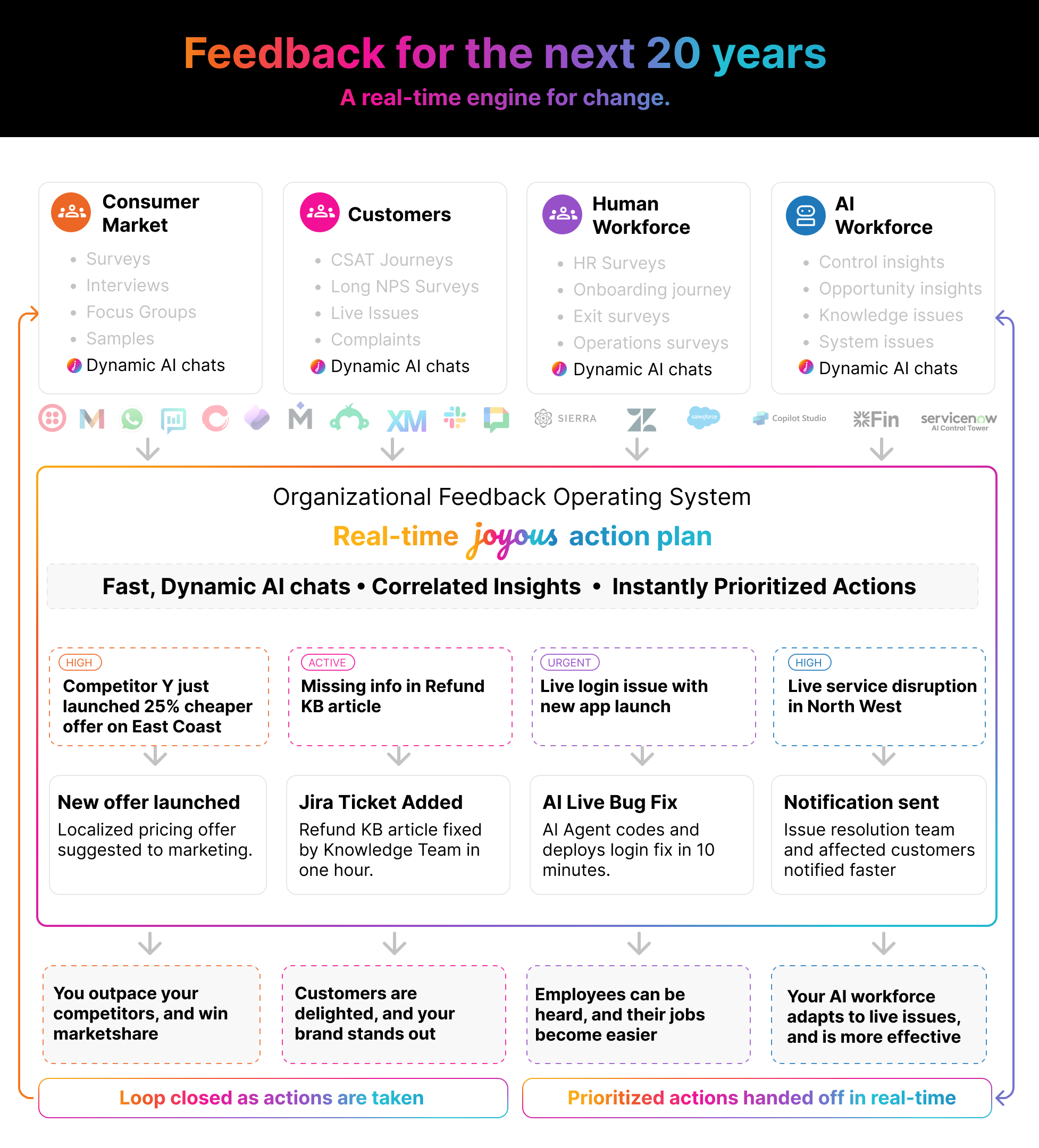
In this example, the useful output isn’t another insight. It is something like:
URGENT - Competitor pricing change is driving an abnormal increase in churn.
Then a specific action plan.
1. Increase frontline discount authority and issue a policy change immediately.
2. Update the relevant knowledge and workflow systems.
3. Give the AI service agent the same authority so it can resolve the request without transferring the customer.
4. Identify the customers who churned today, go back to them and offer them the price they originally asked for.
Now we are talking about feedback doing some actual work. And this is the important shift.
Feedback stops being something an organisation observes. It becomes something the organisation runs on.
A continuous layer that senses what is happening across the market, customers, employees and even AI agents too. One that works out what matters; hands actions to the human or AI capable of doing something about them; and keeps listening to see whether the change worked.
Anything else, is pretty much nostalgia.
This matters even more as AI performs more work. An AI agent can tell you what it did. It can often tell you whether the transaction completed. It can tell you where it failed technically.
But it cannot necessarily tell you whether the customer thought the experience was terrible.
It may not know that its solution created a downstream operational problem for an employee. And it does not automatically know that customers, frontline teams, market signals and other AI agents are all pointing towards the same underlying issue. That broader context matters.
Organisations will need an independent layer that continuously audits the experience being created by both humans and AI, brings all the perspectives together in real-time, and feeds that learning back into the systems doing the work.
The feedback system starts to look much less like a survey platform.
And much more like an operating system for continuous change.
Someone gives you feedback. You do something because of it. You tell them.
Instead, we’ve trained people into this slightly bizarre ritual:
“We value your feedback.”
They give us feedback.
Silence.
Six months later:
“We value your feedback.”
Imagine instead:
“You told us our processes meant we couldn’t match the offer you found elsewhere. We changed that today. If you’re willing to give us another chance, we’ll honour the price and add a $25 credit.”
That feels different. Because something actually happened. That is a real feedback loop.
Over and over again. That ultimately changes what the future of feedback is. Except, for Joyous this is not the future. We can already do this today.
Which brings me back to the uncomfortable question...Did the last 20 years of feedback actually change the outcome?
And, isn't it time to try something different?
NPS, CSAT, engagement scores and benchmarking can all still be useful. But measurement should be one feature of a bigger system. Not the system itself.
If the new approach is genuinely simpler and more automated, we argue it should also be cheaper. So our position at Joyous is becoming pretty straightforward. If you are using an incumbent CX, EX or market-feedback platform, we want to replace it.
We’ll price Joyous at least 25% below what you are currently paying for the platform we replace.
If you are still inside an existing contract, we can cover the transition period at no cost in return for a longer-term agreement afterwards. You don’t need to change everything on day one either. Try our new approach.
Then map out the journey that makes most sense for you. Because perhaps after twenty years of measuring the temperature, it’s time to try changing it.
Good design = more accurate and useful responses. Every question:
And yes, skipping a question is always an option. This keeps participants in control and increases survey completion rates.
The Joyous HR Engagement model is based upon an Open Source project that was released by Joyous in 2019, namely the EX Genome Project. This engagement model has continuously evolved and been regularly updated and revised since.
In 2025, the Joyous HR Engagement Model consists of a library of assets, including survey and campaign templates, all of which are available directly from the tool in the People & Culture category of the Campaign Templates Gallery.
These templates are highly customisable and configurable:
The Employee Experience Genome Project V1.0 was first released in 2019 after 18 months of research. Since then Joyous has incorporated the feedback and analysis of millions of responses in Joyous.
The purpose of the Employee Experience Genome project is to demystify the science of measuring employee experience and engagement - enabling a more transparent, productive workplace. And importantly: to make that science easy to understand and accessible for all.
The premise of the model is that Employee Experience is everything people encounter, observe or feel at work. Employee Engagement is the emotional commitment people have to their workplace.
The model breaks Employee Experience into three core categories that have the greatest impact on engagement: Culture & Environment, Fairness & Inclusion, and Wellbeing. These are complimented by a fourth category: Engagement.
Each category includes three topics. The first release included 25 question pairs offering two rated statements per topic, each with a related open-text question, often referred to as a conversation starter.

A few early adopters in the first two years saw great success with the conversational approach. The biggest success was a shift in the perception that 'nobody is listening' and 'nothing ever changes' as a result of feedback. For many, changes were personal, and therefore highly visible.
Leaders were responding directly to employee feedback. Ensuring a positive employee experience was no longer perceived as the sole responsibility of the HR team. Instead it became a shared responsibility across HR, leaders and the individual employee.
At the same time other adopters faced challenges. Not all teams or industries were ready for open dialogue between managers and employees. Our research discovered a strong correlation in drop off rates to manager engagement.
In all cases, repeated exposure to the same questions led to fatigue - similar to what occurs with traditional surveys - and participation gradually dropped off over time.
Participation rates dropped by 15% to 35% over a six to 12 month period until hitting a plateau.
Another challenge faced was skepticism from senior leaders that the scoring was accurate, due to the open nature of the feedback. Joyous later conducted an experiment which disproved this, however this skepticism remained.
In parallel, many customers started using Joyous for operational feedback. Their goal was to make people's jobs easier by reducing friction in their daily tasks. This not only improves employee experience but also has a positive impact on cost efficiency and productivity. In contrast to the employee experience use case, the operational use case found open and conversational feedback to be effective and universally positive.
Instead of conversations with managers, employees were engaging directly with Subject Matter Experts or Project Leaders right before or after they implemented significant changes in products, services, tools, processes or organisational structure.
Several customers correlated an increase in their employee engagement scores with the shift to using Joyous for operational feedback.
In 2021, Joyous released Employee Experience Genome Project V2.0.
The original question set was revised based on feedback from early adopters, employee comments and exhaustive analysis on the performance of individual questions. The model also expanded to 50 question pairs, enabling two sets to be rotated every six months. The adoption of the revised model saw an initial uplift in adoption and a slower drop off rate for new adopters over time.
In 2022, Joyous released a third version as the Te Reo Māori Employee Experience Genome Project V1.0. As a proudly New Zealand organization Joyous worked with our valued partner, Maurea Consulting, to adapt both the model and the Joyous product to support delivering the model in dual language side-by-side. This was the same 50 question pairs as version 2.0, with some further improvements to the english questions based on feedback and in-line Te Reo Māori versions to support our Kiwi customers in helping to uplift Māori cultural competency.
Over the course of 2022 to 2025, most Joyous customers shifted away from weekly conversations between managers and employees. Today, nearly all Joyous HR customers use a combination of quarterly surveys and action focused campaigns - following the current Joyous HR Engagement Model, outlined in this article.
The EX Genome model has been adapted and refined over the last three years to suit this approach and been renamed to the Joyous HR Engagement Model and action-focused campaign templates targeting specific topics were added to compliment the surveys. This version is not Open Source.
Joyous supports a variety of question types and features to suit different goals — from measuring engagement to collecting targeted, actionable feedback. Three core question types are used in the Joyous HR Engagement Surveys and Campaigns.
A 10 minute assessment (29 questions) of work experience, suitable for annual measurement across engagement, well-being, culture & environment and fairness & inclusion.
Download the template in an excel workbook here.
.png)
A medium length (13 questions) assessment of work experience, suitable for six monthly or annual measurement across engagement, well-being, culture & environment and fairness & inclusion.
A short assessment (6 questions) of work experience, suitable for quarterly measurement.
Targeted conversational campaigns focused on specific improvements on topics such as: Environment, Growth, Role Support & Strategy.
Approach:
Action focused campaigns should only be run one to three months before the organization intends to take action on a focused topic. They are a fast and meaningful way to gather specific actionable ideas from people. This greatly helps improve the quality, awareness and adoption of the prioritised actions.
Download the template in an excel workbook here.

And there you have it! If you made it this far, well done! You now have a comprehensive understanding of how Joyous recommends approaching HR and Engagement with our Employee Experience (EX) product.
Rest assured, your account manager will partner with you on your journey and you will be supported at every step. We are here to work alongside you and will tailor our approach to suit your unique requirements and culture.
If you have any feedback or questions don't hesitate to reach out to your account manager directly.
Ruby set out to be a stand-up comedian, but when that didn’t work out, she became a software engineer instead. Now, as an emerging provocateur and occasional CEO - she works alongside the team at Joyous as they build the future of feedback.